"If AI can design a logo in thirty seconds, why would anyone pay a branding agency?"
It's a fair question, and it deserves a clear answer. AI has changed a lot about how we work at Generator. It hasn't changed what a brand is.
The short version: AI is very good at producing options. Branding is mostly about choosing. The rest of this article is about where that line sits, how we use AI on real projects, and three brands we built that no prompt could have produced.
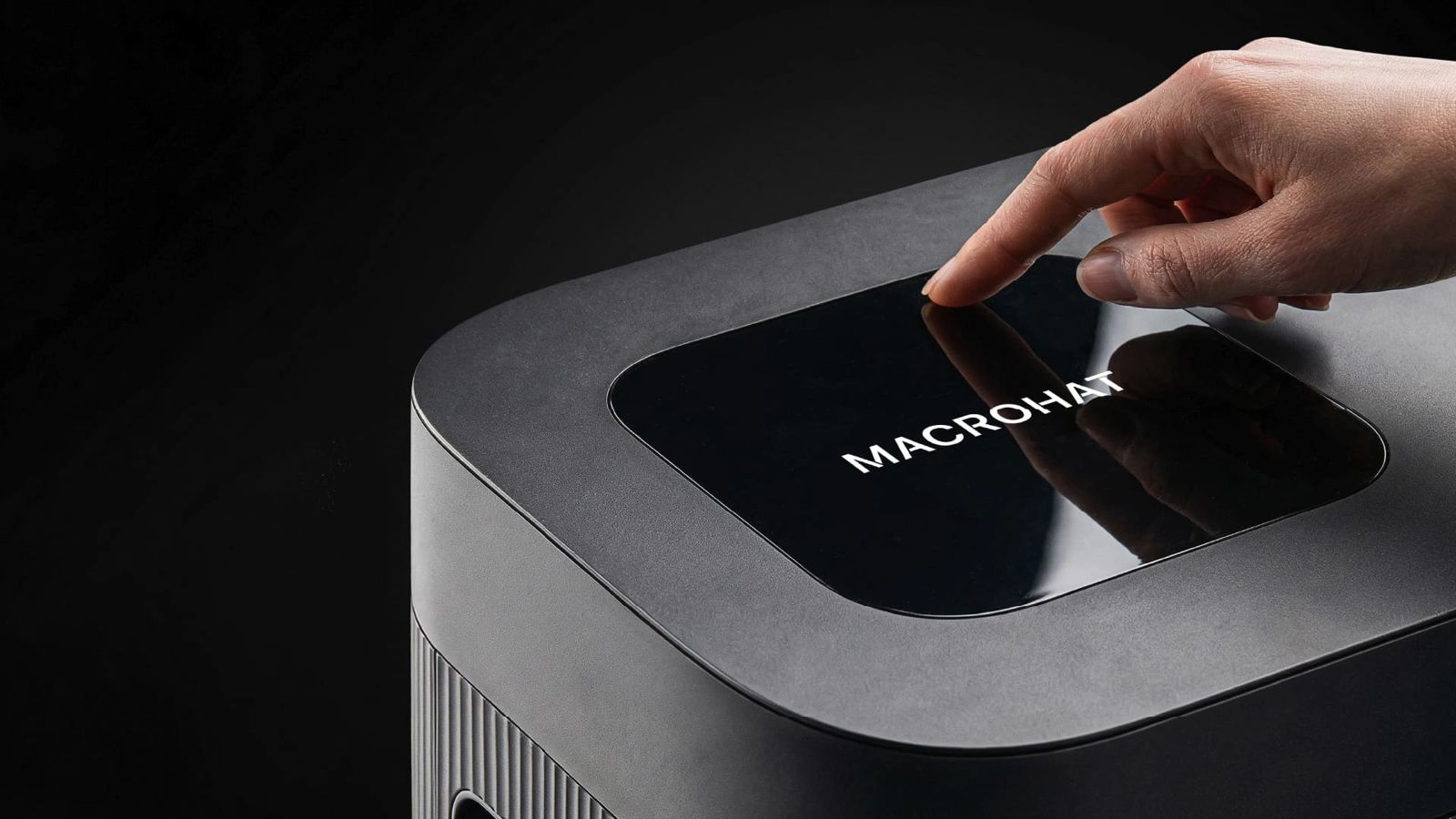
A human hand on the technology. Macrohat, the London smart home brand we designed.
What AI actually changed in branding
Three things got dramatically faster: research, exploration and production. What used to take a strategist a week of reading can now be summarised in an afternoon. A designer can look at twenty directions before lunch instead of five. Adapting a finished identity across fifty formats takes hours, not days.
What didn't get faster is judgement. Deciding what a brand stands for, who it's really for, and what it should refuse to be. Those questions take as long as they always did, because they depend on understanding a business, a market and the people in it.
| Where AI accelerates | Where humans lead | |
|---|---|---|
| Research | Summarising markets, reviews and competitors | Deciding which insight actually matters |
| Naming | Generating hundreds of candidates | Checking meaning, sound and culture in Arabic and English |
| Visual exploration | Moodboards and quick variations | Picking the direction that's ownable, not just attractive |
| Copy | First drafts and alternatives | Finding a voice that sounds like one company, not every company |
| Production | Resizing and adapting across touchpoints | Guarding consistency and signing off |
| Decisions | None | All of them |
Where AI earns its place in our process
We use AI at Generator, and we don't hide it. It's a tool, the same way a camera or a type foundry is a tool. Mostly it shows up in three places.
Research that used to take a week
Before we design anything, we need to understand the market: competitors, customer reviews, category language, what's already been done. AI is excellent at digesting that volume and pointing out patterns. It means our strategy team spends less time collecting and more time thinking. The thinking is still the job.
More directions on the table, earlier
Early in a project, AI helps us explore wider and faster: rough moodboards, naming territories, visual references. That's genuinely useful. But there's a catch every designer learns quickly. AI is trained on what already exists, so its first answers drift towards the average of everything it has seen. Branding's whole job is the opposite. So we treat AI output as a starting point to argue with, never as the answer.
Production at scale
Once an identity is designed and approved, it has to live on packaging, social posts, signage, presentations and screens in two languages. AI speeds up a lot of that adaptation work. A person still checks every piece, because consistency is where brands quietly fall apart.
Where humans still lead
Culture and context
Most of our clients are in Saudi Arabia, Egypt and the Gulf. A name that sounds sophisticated in English can sound odd, or worse, in Arabic. A colour that feels premium in London can feel like mourning somewhere else. A tone that works for a Riyadh family brand won't work for a London tech company. AI can flag some of this if you ask the right questions. Knowing which questions to ask is the human part.
Strategy and accountability
AI can recommend a positioning. It can't be responsible for it. When a founder bets their launch on a brand direction, someone has to stand behind that decision, explain it to a board, and live with it for the next ten years. That's what a brand strategy partner is for.
Taste and emotion
There's a difference between correct and memorable. AI is getting very good at correct. Memorable usually comes from a decision that looks slightly wrong at first: a bird where you expected a flower, a name nobody would have predicted, a restraint that feels almost too quiet. Those calls come from people who care about the outcome.
Team structure: how each of us uses AI
Generator is a Cairo-based team of strategists, designers, writers and developers, with deep experience in interaction design and prototyping. Every one of them uses AI now. No two of them use it the same way. Here's what that looks like around the studio.
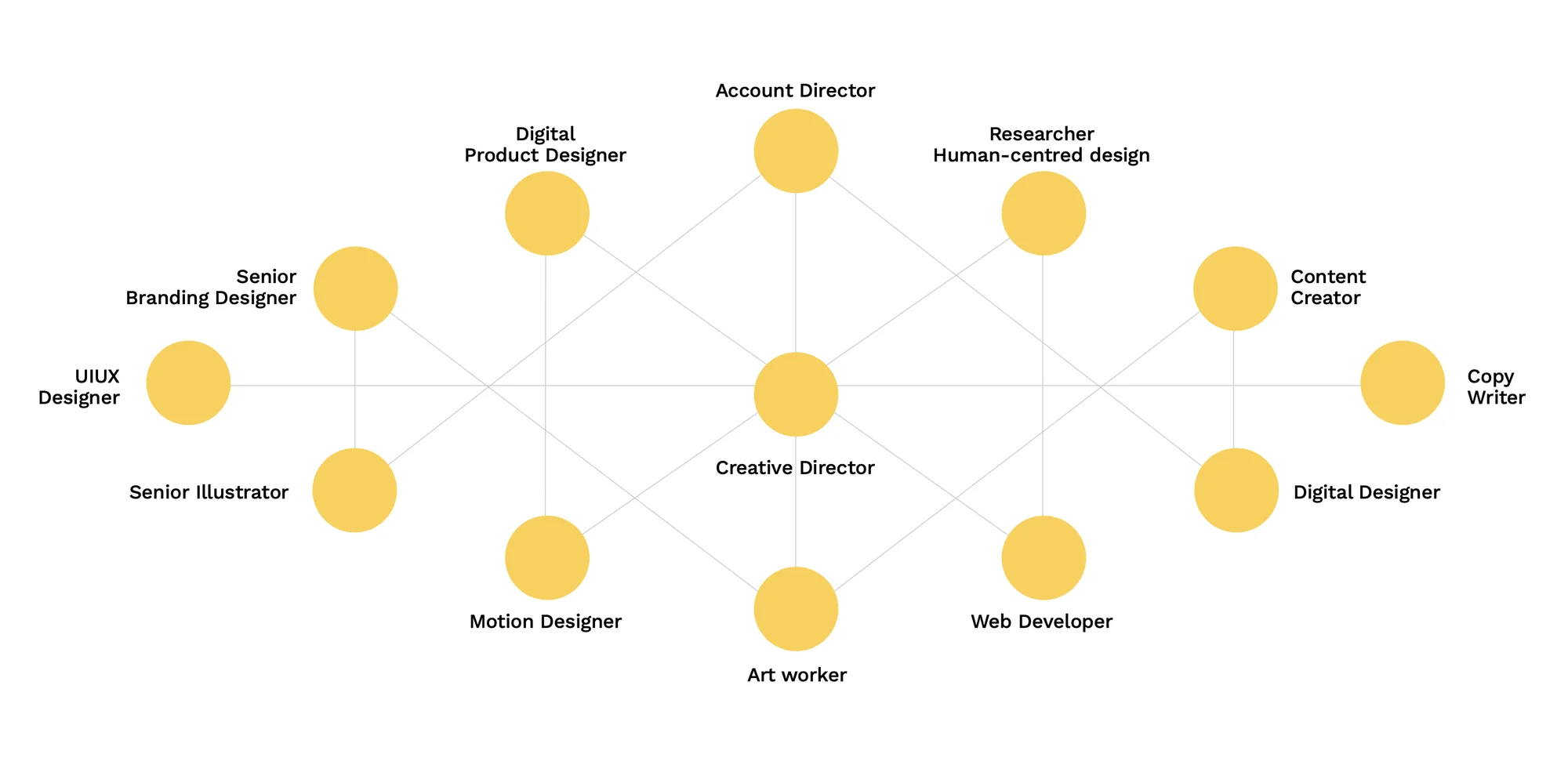
The Generator team. Every role connects back to creative direction.
Leading the work
Creative Director. Uses AI to widen the first round of exploration and to pressure-test a direction before it reaches the client. Still makes the final call on every concept that leaves the studio.
Account Director. Uses AI to turn meeting notes into clear briefs, timelines and follow-ups in minutes. The relationship, and knowing what a client really means when they say "make it pop," stays human.
Understanding people
Researcher, human-centred design. Uses AI to digest interviews, reviews and market data in hours instead of days, and to flag patterns worth chasing. Then goes and talks to real users, because that's where the insight actually is. This is the person who keeps our design thinking process honest.
Copywriter. Uses AI for volume: headline options, naming territories, tone tests. Writes the final line by ear, in Arabic and English.
Content Creator. Uses AI to plan calendars, draft captions and adapt one idea across platforms. Decides what's worth saying, and when to say nothing.
Shaping the identity
Senior Branding Designer. Uses AI for fast moodboards and early visual territories. Builds the identity system itself by hand, because an ownable mark can't be averaged out of what already exists.
Senior Illustrator. Uses AI to gather references and test compositions. Draws the final work, which is what makes an illustration system belong to one brand and nobody else.
Digital Designer. Uses AI to resize, adapt and version campaign assets across dozens of formats. Checks every piece against the guidelines before it goes out.
Art worker. Uses AI to speed up file prep, cut-outs and production checks. Owns print accuracy: colour, bleed, dielines, all the details that cost real money when they're wrong.
Building the experience
UI/UX Designer. Uses AI to draft user flows, placeholder content and quick layout variations for testing. Designs the final experience around what real users actually do, not what the tool predicts.
Digital Product Designer. Uses AI to prototype interactions faster and explore edge cases early. Decides what the product should do, and just as importantly, what it shouldn't.
Motion Designer. Uses AI for storyboards, style frames and some of the in-between work. Directs timing and feel, the part that makes motion look intentional rather than automatic.
Web Developer. Uses AI as a coding assistant for boilerplate, testing and debugging. Owns performance, accessibility, security and every line of code that ships.
Thirteen roles, thirteen different uses. The pattern underneath is the one from the table at the top: AI takes on the volume, and a person makes the call.
Three brands no prompt could have made
These are recent Generator projects. Each one turned on a decision that no tool would have made for us.
Flair: the idea AI wouldn't have found
Flair is a luxury floral boutique in Saudi Arabia. Ask an AI tool for a luxury florist identity and you'll get roses, gold foil and a script font. It will look fine, and it will look like every other florist.
We started from what flowers actually do for people: they say what words often can't. That became the core of the brand, flowers as "a language of presence, emotion and refined beauty." Two rules from the guidelines shape everything else: luxury lives in simplicity, and imagery captures feeling before product. The logo is a hoopoe, and the illustration system draws on florals, architecture and decorative artistry, with its own sets for everyday gifting, special occasions and Saudi National Day. Even the voice follows the idea. One line sums it up: "Luxury isn't loud. It blooms."
Pages from the Flair guidelines: the hoopoe mark, the colour palette, the illustration sets and the packaging.
Macrohat: making technology feel human
Macrohat is a London-based smart home company. Its whole promise is invisible systems that blend into interior design, controlling lighting, climate, entertainment and security without spoiling the room. That's the irony of the brief: a technology brand whose job is to make technology disappear.
It was also a rebrand, an evolution rather than a blank page. The new logo keeps the bold, block-like geometry of the old one, refined into what the guidelines call an architectonic form, so existing clients still recognise it. The palette is almost silent: black, a warm light beige and three greys. Deciding what to keep and what to leave out were the two most important calls in the project, and neither is what AI is built for. It's built to add.
Macrohat's poster series: black, warm beige, and a lot of breathing room.
Meeda: a name that had to work in Arabic first
Meeda is a Saudi frozen food brand serving busy families at home, and restaurants, supermarkets and grocery stores at scale. It had to stand out in freezers full of long-established names, feel rooted in Saudi life, and still look modern.
AI can generate a thousand food brand names in a minute. Most will be taken, forgettable, or quietly wrong in Arabic. Naming Meeda meant finding something that sits naturally in Arabic, where the logo leads with ميدا, and still reads cleanly in English. The guidelines describe the personality as warm and inviting, playful and colourful, and the Arabic voice matches it: بكل حب وسهولة, "with love and ease." Then came a packaging system that stretches from mango, avocado and passion fruit to chicken breasts, shrimp and tahini, without losing clarity on a crowded shelf.
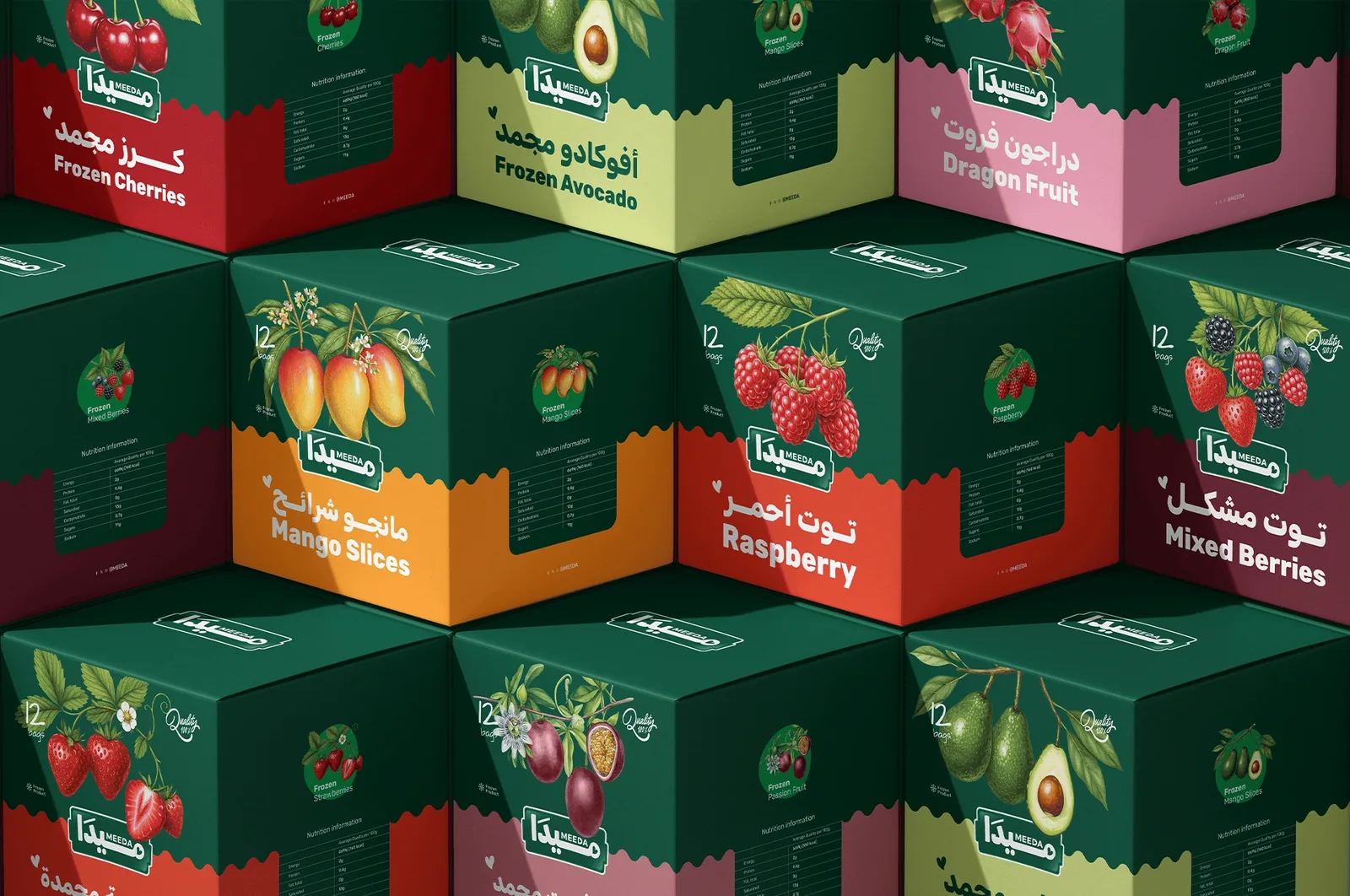
One system, dozens of products: every Meeda box leads with Arabic and stays clear in English.
How to tell if an agency uses AI well
Every agency uses AI now, or will soon. The useful question isn't whether they use it, but how. A few things worth asking:
- Where exactly does AI show up in your process? A clear, specific answer is a good sign. "Everywhere" and "nowhere" are both worrying.
- Who makes the final call on strategy and design? You want a named person, not a tool.
- How do you make sure the work is original? Ask how they check names and visuals against what already exists, and how they handle trademark searches.
- Can I see the strategy behind the work? If there's nothing before the visuals, the visuals were guessed, with or without AI.
- How do you handle Arabic? Ask to see Arabic that was designed, not translated or generated.
Common questions
Can AI replace a branding agency?
It can replace some of the production work. It can't replace the decisions: what your brand stands for, who it's for, what makes it different, and whether a name or idea works in your market. Those still need people who understand the business and the culture.
Can AI design a logo?
It can generate one in seconds. Whether that logo is distinctive, meaningful, consistent with a wider identity system and safe to register is a different question, and that part still takes human work.
How does Generator use AI in branding?
Mainly in three places: digesting research faster, exploring more creative directions early on, and adapting finished work across touchpoints. Strategy, creative direction and every final decision stay with our team.
Can I trademark a logo made with AI?
The law is still unsettled in many countries, and purely AI-generated work may not be protected in the same way as human-made design. If ownership matters to you, and it should, make sure real human authorship is involved and check with a trademark lawyer before you launch.
Does AI make branding cheaper?
It makes some tasks faster, mostly research and production. The thinking, the craft and the approvals take about as long as they always did. In practice AI moves time around more than it removes it.
Ready to build a brand no prompt could have made?
We'd be pleased to talk through where your brand is today and where it needs to go. Generator works with growing companies across Saudi Arabia and Egypt, using the best tools available and a team that knows which decisions matter. It would be a pleasure to hear from you.
Start a conversationGenerator Design Agency · Cairo, Egypt · Working across Saudi Arabia & Egypt · See more work · Our services