"So what do we actually stand for?"
A business can have a good product, an experienced team and a serious marketing budget, and still struggle to explain why customers should choose it. The sales team talks about quality. The website talks about innovation. Social media talks about price. Leadership calls the company premium, while customers compare it with cheaper alternatives.
None of those messages is wrong on its own. The problem is that they don't add up to one clear position. That is the problem brand strategy services in Egypt should solve: not a document about mission and values, but a set of decisions about who the business serves, what it wants to be known for, how it differs from competitors, and how those decisions guide everyone who speaks for it.
The cost of having no clear strategy
A missing strategy rarely looks like a branding problem. It shows up as marketing that changes direction every quarter, a sales team that struggles to justify its prices, or a website that gets redesigned again because nobody agrees on what it should say. In growing companies, it shows up as departments, products and subsidiaries that no longer feel connected.
Branding won't fix every commercial problem. But when the real issue is an unclear position, producing more marketing material makes it louder, not clearer. The business has to make a few decisions first: what it wants to be known for, which customers matter most, what value it can credibly claim, and what it should stop trying to say. A useful strategy makes those choices explicit.
What brand strategy services include
A strategy engagement should be shaped around the organisation's real challenge. For one company the priority is entering a new market; for another it is bringing several subsidiaries under one coherent identity. Each part of the work should answer a business question, not fill a slide.
| Part of the work | The question it answers |
|---|---|
| Discovery and stakeholder interviews | What does leadership want, and where do they disagree? |
| Audience research | Who actually buys, and what do they need to believe? |
| Competitor analysis | Where is the market crowded, and where is there room? |
| Positioning and value proposition | Why should the right customer choose us over the alternatives? |
| Personality and tone of voice | How should we sound in Arabic and English? |
| Messaging hierarchy | What do we say first, second and only when asked? |
| Brand architecture and naming | How do our companies, products and names relate? |
| Guidance for design and communication | How should every team turn this into work? |
Our brand strategy service connects these parts within the wider branding process.
Positioning: choosing what to be known for
Positioning is usually the hardest part of strategy because it forces choices. Many businesses want to be premium and affordable, innovative and traditional, specialised and right for everyone. Some combinations are possible; others create expectations the company can't meet every day.
Strong positioning doesn't reduce a company to one adjective. It finds a credible reason for the right customers to choose it over the real alternatives. Picture two consultancies offering the same strategy, operations and transformation services. One positions itself around helping large organisations manage complex institutional change. The other makes growth systems practical for founder-led companies. Same capabilities, different reasons to be chosen, and different customers who will call.
The result is not a slogan. It is a decision that shapes services, messaging, design and customer experience. For WOTN, a Saudi event management company working with government and private sector clients, the strategy was built around four values: innovation, excellence, speed and added value. Every later choice, from the identity to the website copy, was checked against them. More on this stage on our brand positioning page.

Research should challenge assumptions
Most organisations already have a story about themselves. Leadership knows why the company was founded and where it wants to go, and that knowledge matters. But internal perception is not the same as market perception. Customers may choose the business for reasons leadership rarely mentions, competitors may be making the same claims, and a supposed advantage may be common across the whole category.
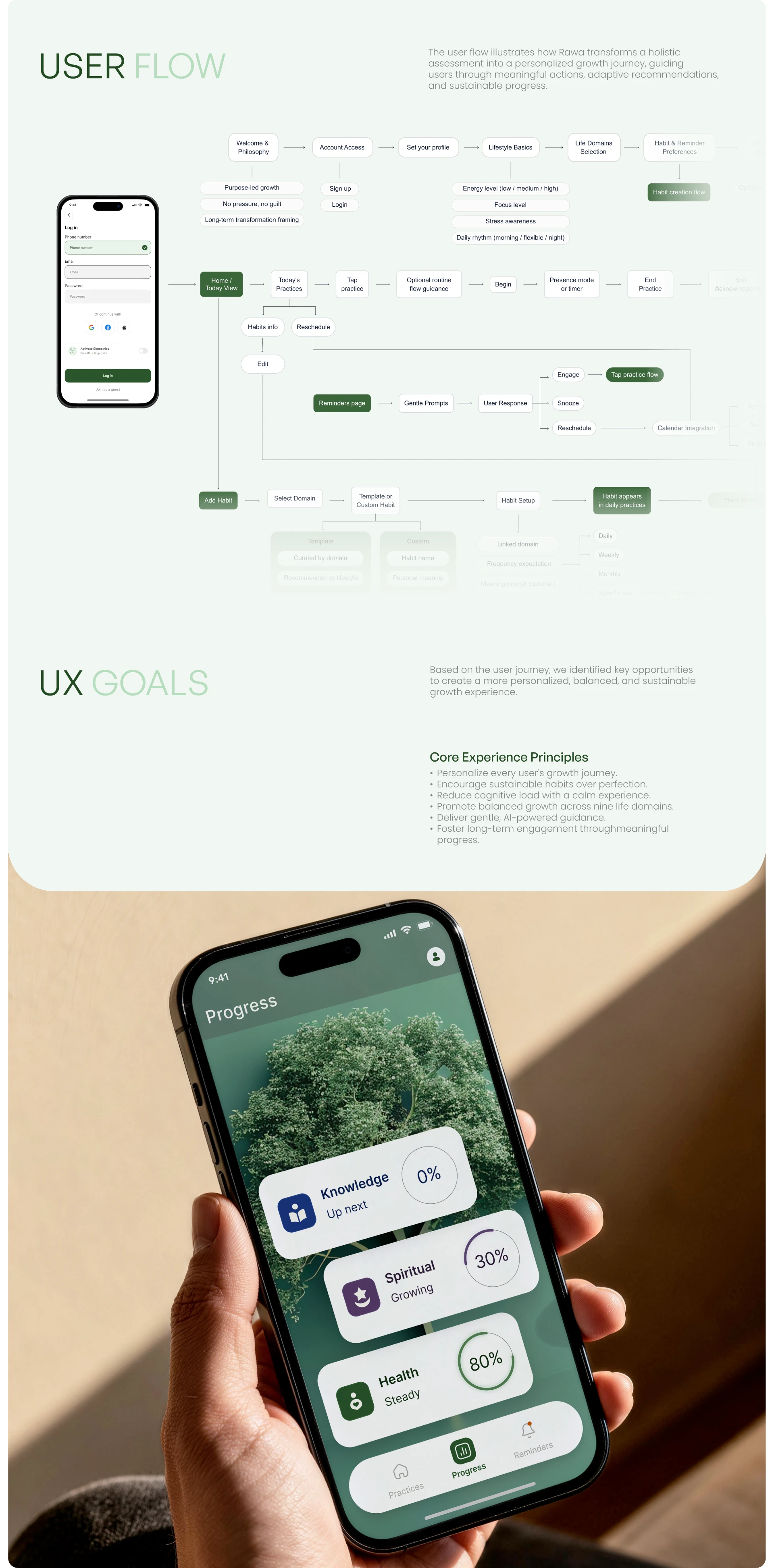
Research exposes those gaps. Depending on scope, it can mean stakeholder interviews, customer conversations, competitor reviews and an audit of existing communication. For RAWA, a wellness app, the starting point was the category itself: most wellness brands sell goals, discipline and results, which left room for a brand that does the opposite.
A strategy the business can use
A common failure of strategy projects is a final presentation that sounds convincing and changes nothing. The company receives a positioning statement, a personality framework and a list of values. Then the marketing team asks what to put on the website, how the sales deck should change, which messages come first, and where the new product fits.
A useful strategy answers those questions. It defines a messaging hierarchy, audience priorities, proof points, tone of voice and how different offers relate. It also says where the rules apply and where teams can use judgement.
Can people who were not involved in the strategy use it to make better decisions? If not, the work isn't finished.The test we apply to every strategy

When the business has more than one brand
Strategy gets harder as a business grows. A company that started with one service ends up with several business units, a family group acquires new companies, a developer launches project after project, a healthcare group opens specialist clinics. At that point leadership has to decide how the brands relate: whether the parent leads, whether each subsidiary stands alone, or whether a hybrid works better.
There is no universally right structure. It depends on ownership, how much the audiences overlap, existing recognition and where the group is going next, and it is far easier to decide before the business collects a confusing set of names and logos. We go deeper into this in our article on building one identity across a growing group, and our brand architecture service covers the work.
From strategy to identity
A strategy should guide the identity without dictating every creative detail. A company positioned around clarity and access needs a different visual approach from one built around experiment and expression, and that difference shows up in typography, colour, imagery, layout, motion and tone of voice. There is rarely only one right answer, so creative exploration still matters.
What strategy changes is the conversation. Instead of asking whether leadership likes a design, the team can ask whether it says the intended thing to the intended audience, and whether it works on real applications. See how that carries into our brand identity design work.


Brand strategy in practice: RAWA
RAWA is a wellness app that helps people build healthier habits, reflect on their progress and improve their lifestyle. The category it entered usually speaks the language of goals, discipline and results. RAWA set out to do the opposite: encourage growth without pressure.
That made strategy the first piece of work, before any design. We started with brand strategy and naming, built around one simple belief: meaningful growth comes from small, consistent steps. The creative concept, inspired by gradual nourishment and continuous growth, then shaped the name, logo, visual identity, brand personality and the UI/UX of the app. The lesson is not that every app needs a soft voice. It is that the strongest creative decisions come from a clear position that the whole product can follow.


Taking a strategy into Saudi Arabia
A position that works in Egypt may not travel on its own. Saudi buyers may compare competitors differently, a category may be more mature, and the same message can land differently with a different audience. Expansion is a strategy question first: who you are competing with now, what those customers care about, and whether your value proposition still stands out.
That doesn't mean every market needs a different brand. The aim is to decide what stays consistent and what adapts. Much of our work is exactly this: brands for Saudi clients such as WOTN, built by our team in Cairo.
When you need a strategy project, and when you don't
Not every business needs a full strategy engagement. If your position is already clear and you need a campaign, a marketing agency may serve you better. If the brand is sound but applied inconsistently, updated guidelines may be enough. A deeper strategy project makes sense when:
- Customers struggle to understand what makes you different.
- Leadership, sales and marketing describe the company in different ways.
- You are entering a new market or category.
- Several subsidiaries need a clearer relationship.
- The business has changed a lot since its identity was created.
- A rebrand is being discussed without a clear reason.
If a rebrand is already on the table, our guide to rebranding services in Egypt helps you work out which kind you need.
Deliverables and cost
What a strategy deliverable looks like
A strong deliverable is specific to the organisation. It may include a research summary, audience priorities, competitor analysis, a positioning platform, value proposition, messaging hierarchy, personality, tone of voice and implementation guidance. For complex organisations it can also cover brand architecture, naming principles and guidance for different markets or business units.
The format matters less than whether people use it. A short strategy that teams apply every week is worth more than a long presentation nobody opens after launch.

What brand strategy costs in Egypt
There is no standard price. A focused positioning project for a startup is a different job from a corporate strategy involving many stakeholders, audiences, markets and subsidiaries. Cost depends on the depth of research, the complexity of the organisation, the number of brands and the deliverables required. When comparing proposals, ask which decisions each one will help you make. A presentation of mission, vision and values is not the same as a research-led strategy.
Choosing a brand strategy partner
A strong portfolio proves creative ability, not strategic ability. A good first meeting is about your business before it is about visuals: your customers, competitors, commercial goals, internal tensions and plans. Ask how research shapes the positioning, what happens when stakeholders disagree, how recommendations become messaging and design, and what your team will be able to do differently afterwards.
Generator is most useful when strategic decisions need to connect to a whole brand system: a new market position, a group of brands that need structure, regional expansion, or an identity built around a clearer proposition. Not every company needs all of that, and we'll say so. For a wider view of the market, read our guide to branding companies in Egypt.
Frequently asked questions
What are brand strategy services?
Brand strategy services help a business decide who it serves, what it wants to be known for, how it differs from competitors and how it should speak. Typical work includes research, positioning, value proposition, messaging, brand architecture and guidance for design and communication.
What is the difference between brand strategy and brand identity?
Brand strategy is the thinking: audience, position, promise and personality. Brand identity is how that thinking is expressed: the name, logo, typography, colour, imagery and tone of voice.
How long does a brand strategy project take?
It depends on the size of the organisation, the depth of research and how many people need to agree. A focused positioning project takes far less time than a multi-brand strategy for a corporate group.
Does a startup need brand strategy?
Yes, at the right scale. A startup needs clarity about its audience, proposition and difference, but usually not the research depth or deliverables an established group needs.
Can brand strategy support expansion into Saudi Arabia?
Yes. Strategy helps a business test whether its positioning, messages and brand structure still hold for Saudi audiences and competitors, and decide what should stay consistent and what should adapt.
Does Generator offer brand strategy services in Egypt?
Yes. Generator is a branding agency based in Cairo, providing research, positioning, messaging, brand architecture and the identity work that follows, for businesses in Egypt, Saudi Arabia, the UAE and across MENA.
Which decision is your brand stuck on?
Tell us where your business is heading and what your brand can't explain yet. We'll start with the decisions, not the design.
Which decision is your brand stuck on?
Tell us where your business is heading and what your brand can't explain yet. We'll start with the decisions, not the design.
Start a conversation See our brand strategy serviceGenerator Design Agency · Cairo, Egypt · Working across Egypt, Saudi Arabia, the UAE & MENA · See more work · Our services